Launch offer — valid today only

General Class (Element 3): Every Topic on One Page, Drawn From Band Edges to RF Safety, in the Order of the Official G1 to G0 Syllabus

Band edges, sidebands, the ionosphere, decibels, PEP, SWR, feed lines and RF safety: in your notes it's a wall of text. Here each topic fits on one page, with the drawing and what you need to remember. 69 illustrated pages.

YES, I WANT THE DRAWN PAGES

🔒 Secure checkout · PDF by email · 30-day guarantee

One topic per pagethe drawing teaches you the concept and the text backs it up
69 illustrated pages12 parts, from how the exam works to RF safety
Up-to-date sources47 CFR Part 97 and the NCVEC 2023-2027 pool (Feb. 2026 errata)

This Is What the Pages You Will Study Look Like

One topic per page, the drawing that shows you how it works and the boxes with what you need to know:

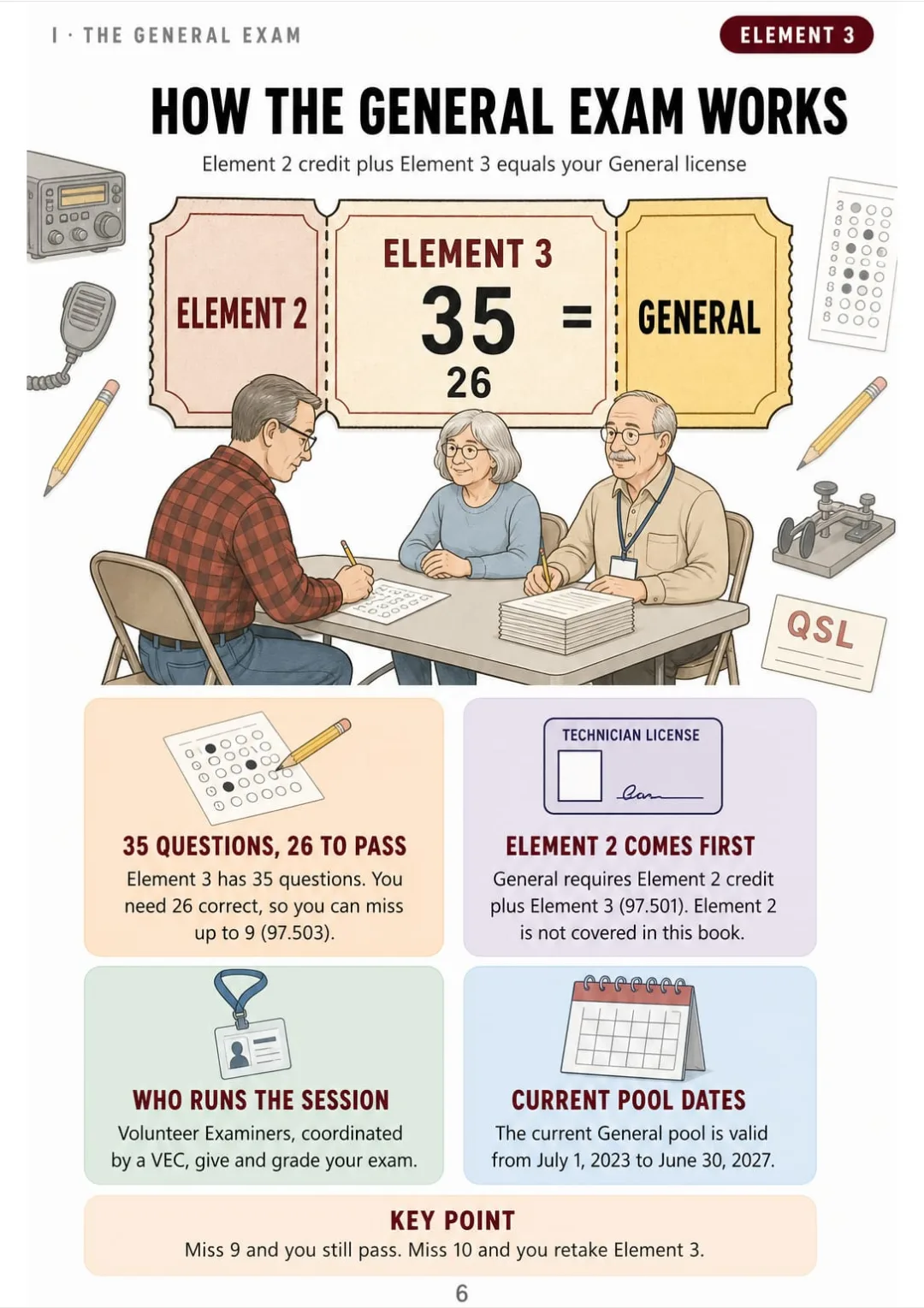
Element 2 credit + Element 3 (35 questions, 26 to pass) = General.
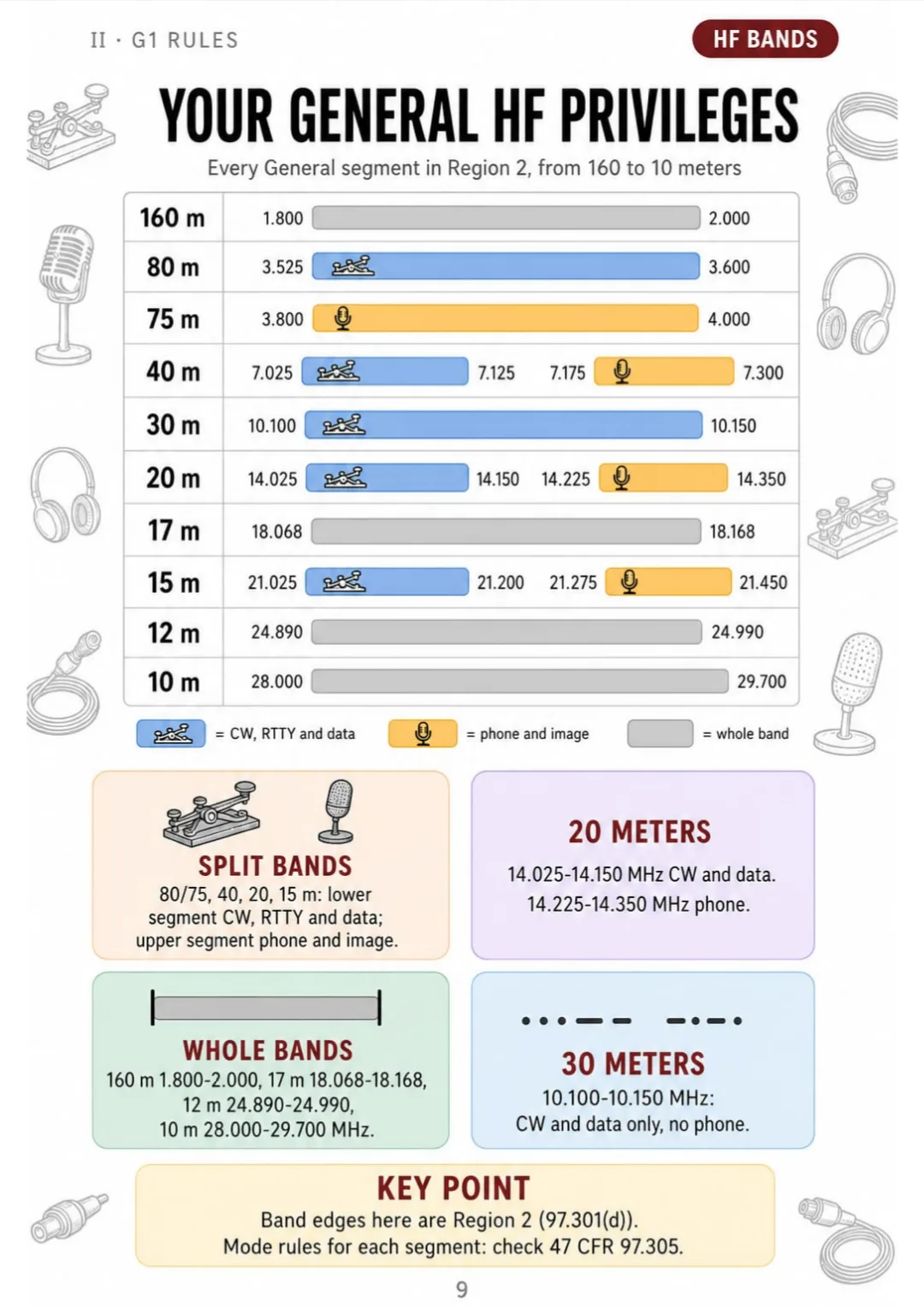
20 m: 14.025-14.150 MHz CW/data · 14.225-14.350 MHz phone
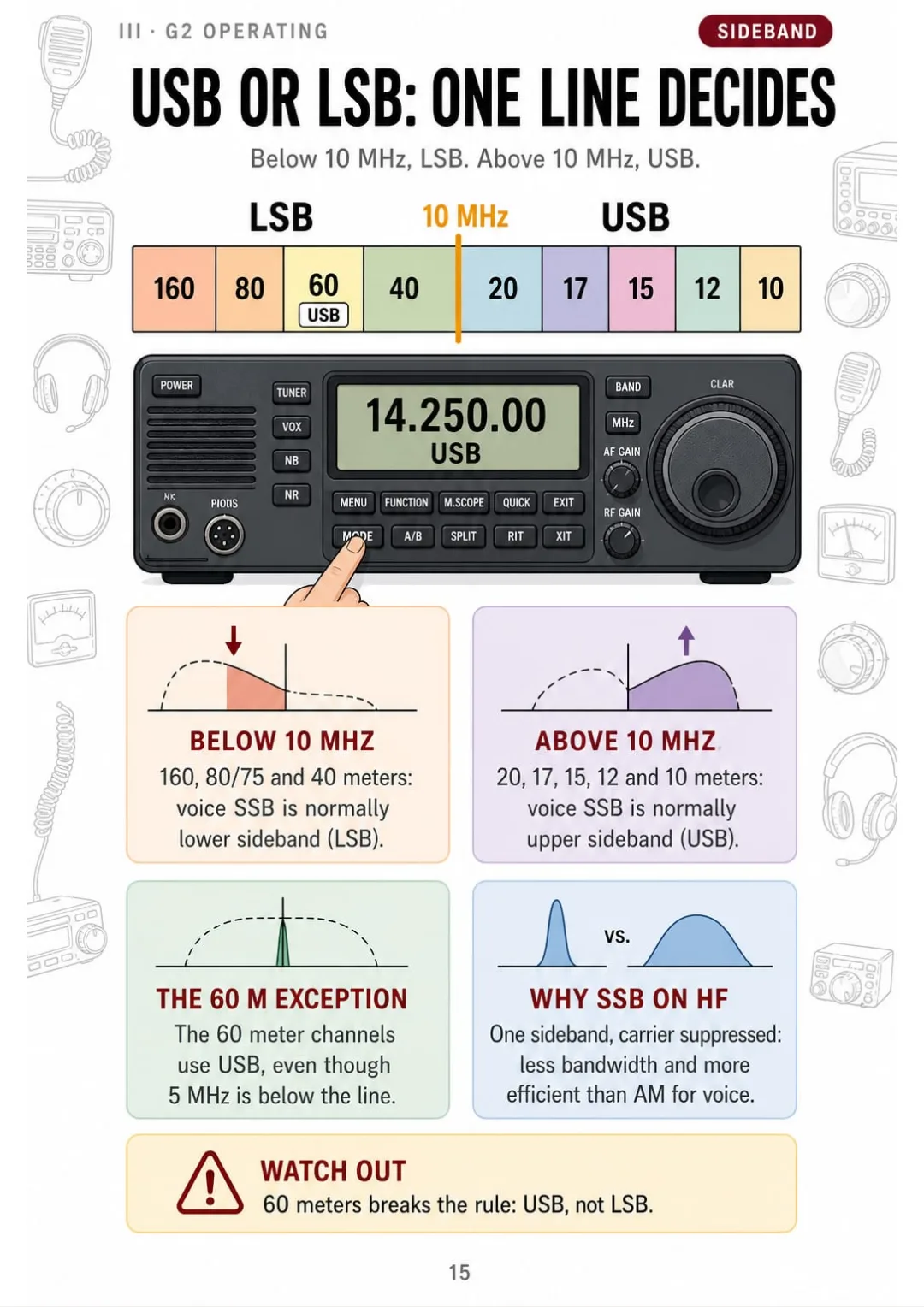
LSB below 10 MHz, USB above it, and USB on the 60 m channels.
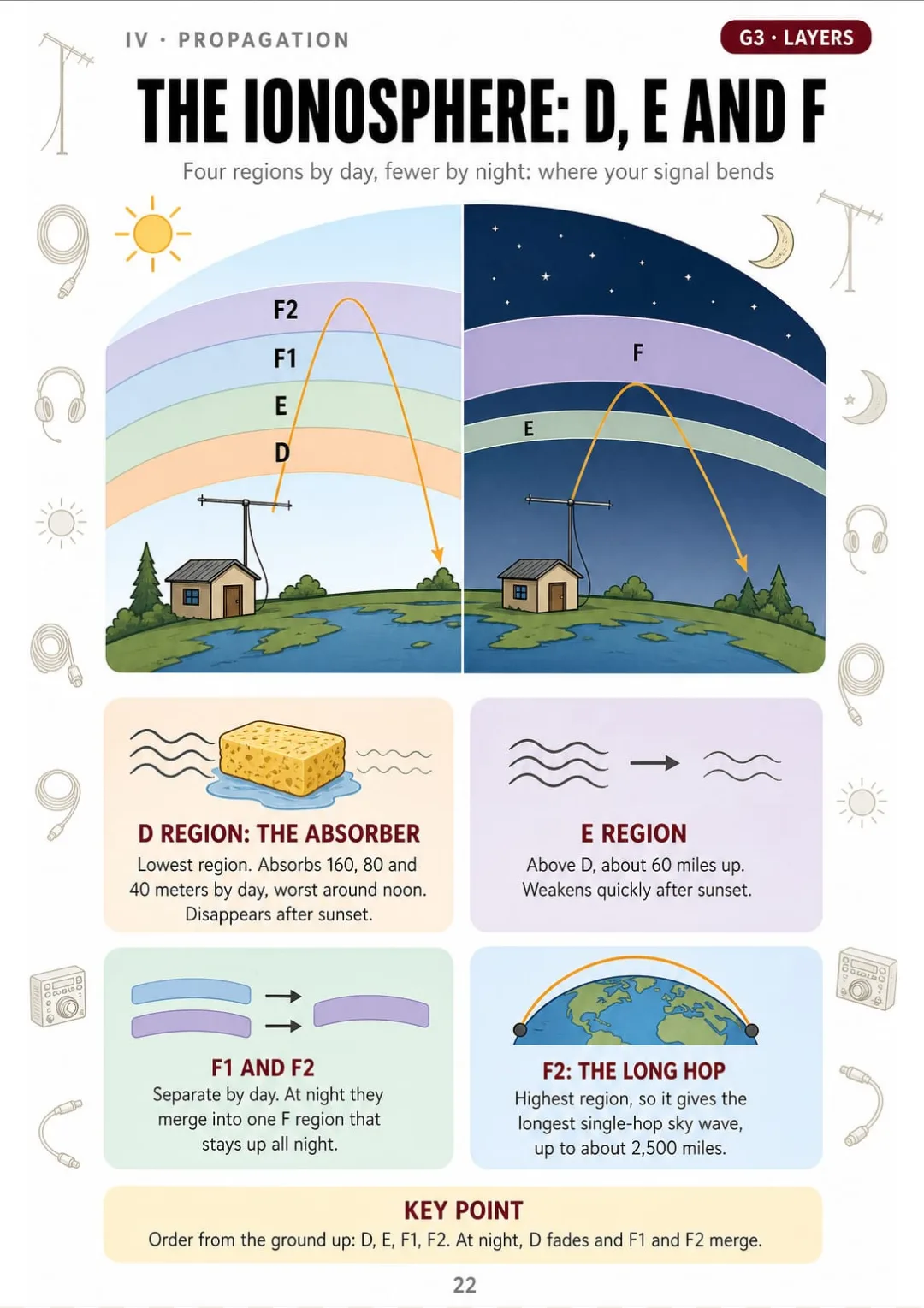
D, E, F1, F2 from the ground up: day side vs. night side on one curved Earth
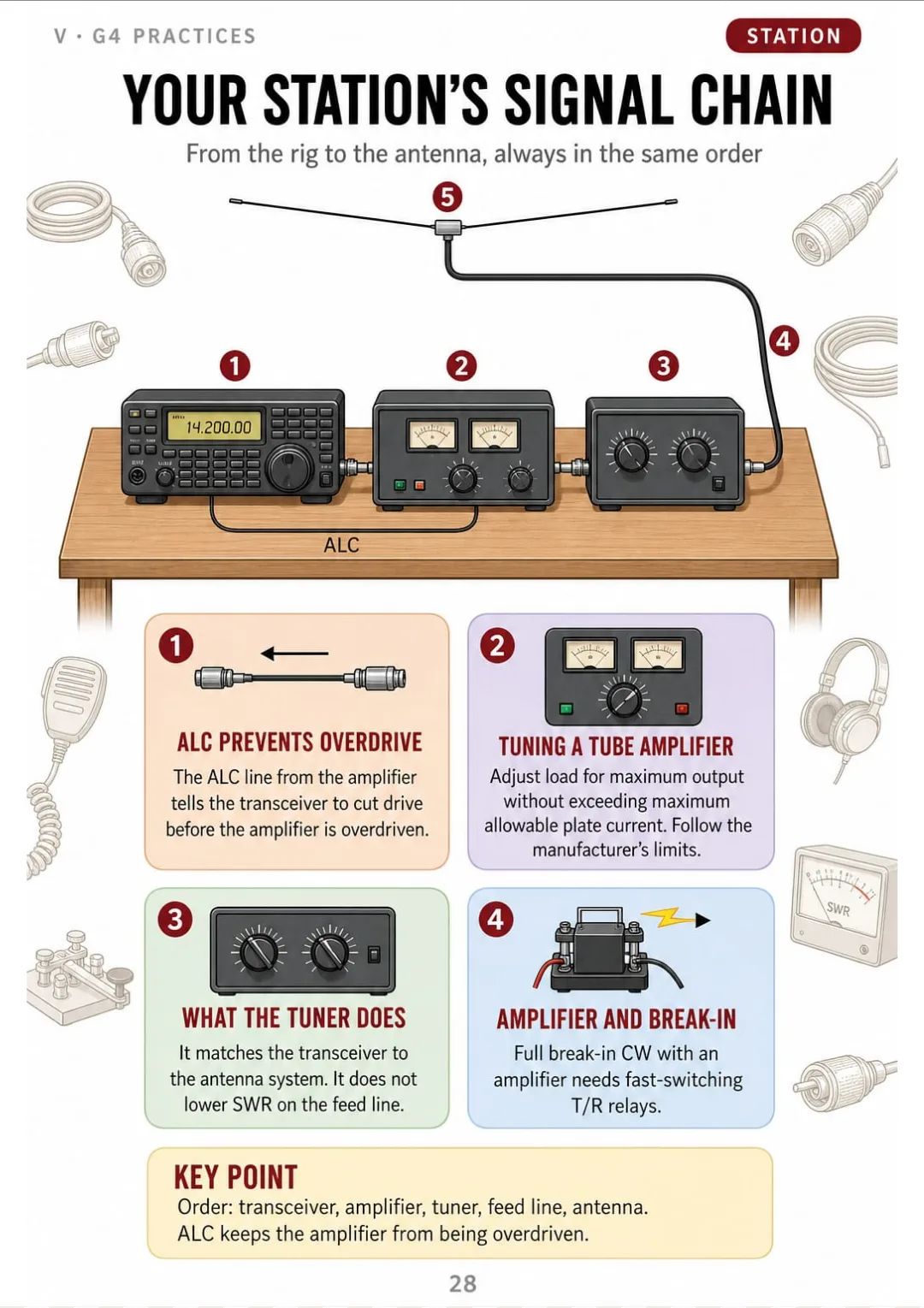
Transceiver → amplifier → tuner → feed line → antenna, with the ALC line drawn in
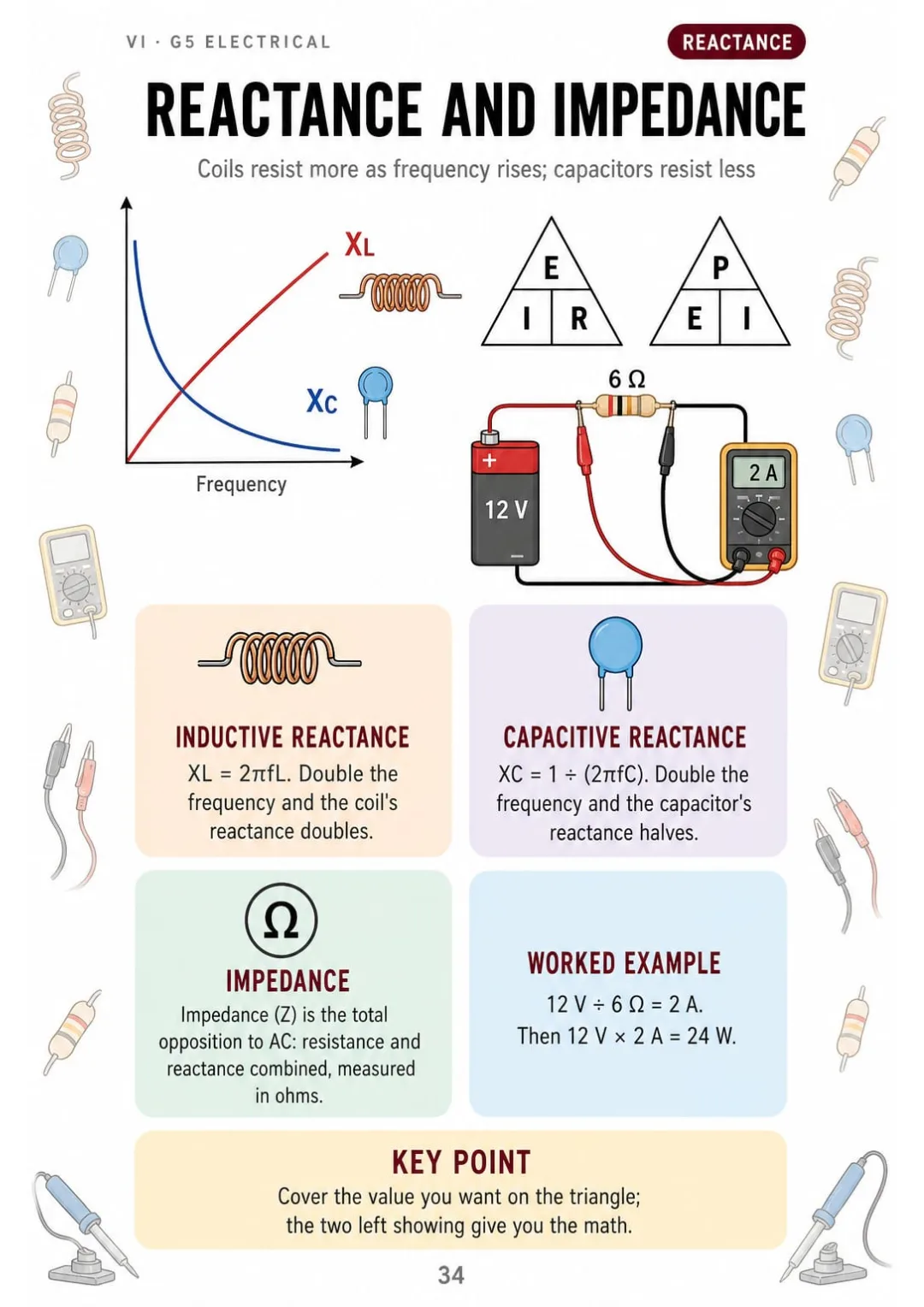
XL rises with frequency, XC falls · 12 V across 6 Ω = 2 A and 24 W
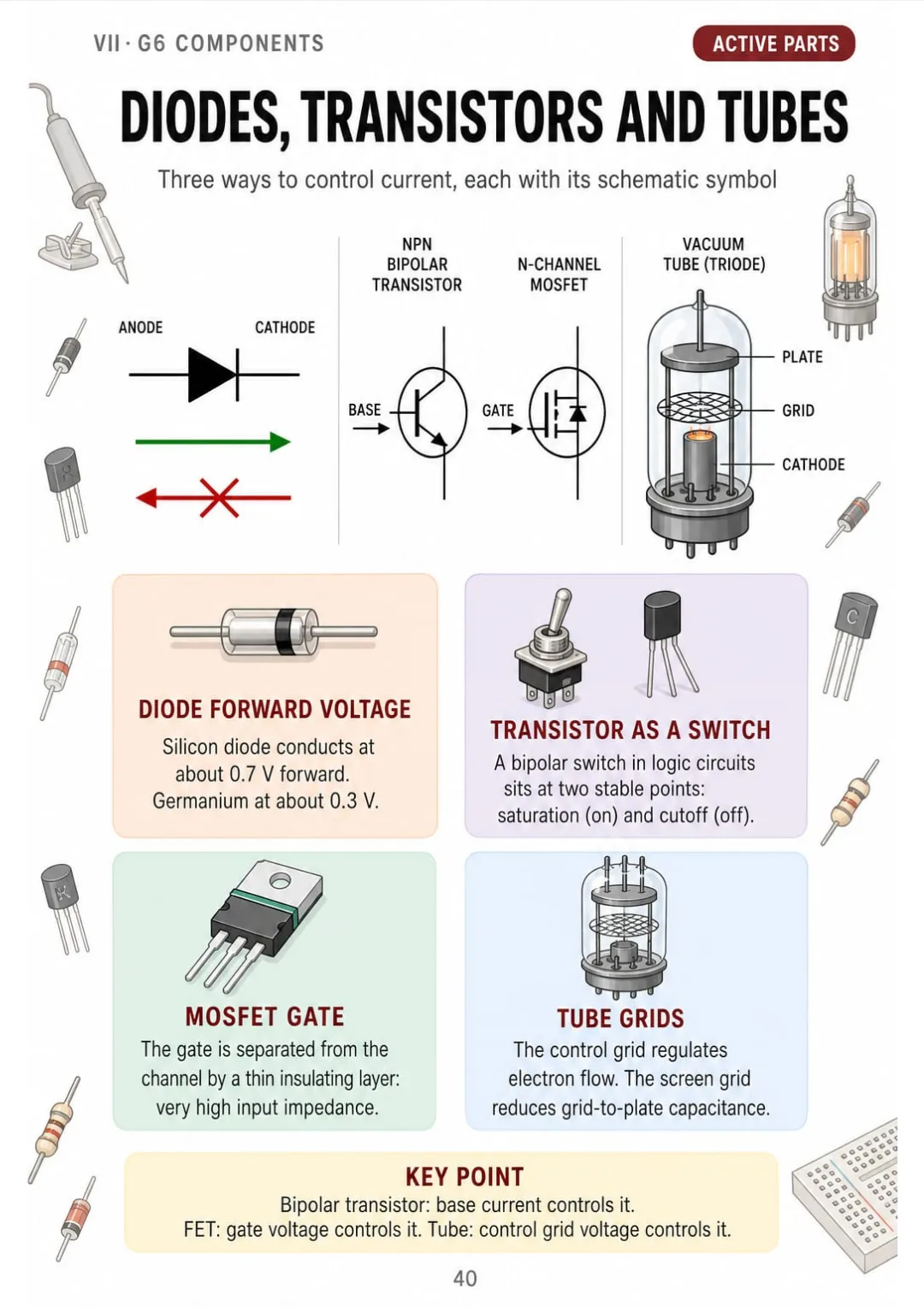
Silicon 0.7 V, germanium 0.3 V, and the control grid that regulates electron flow.
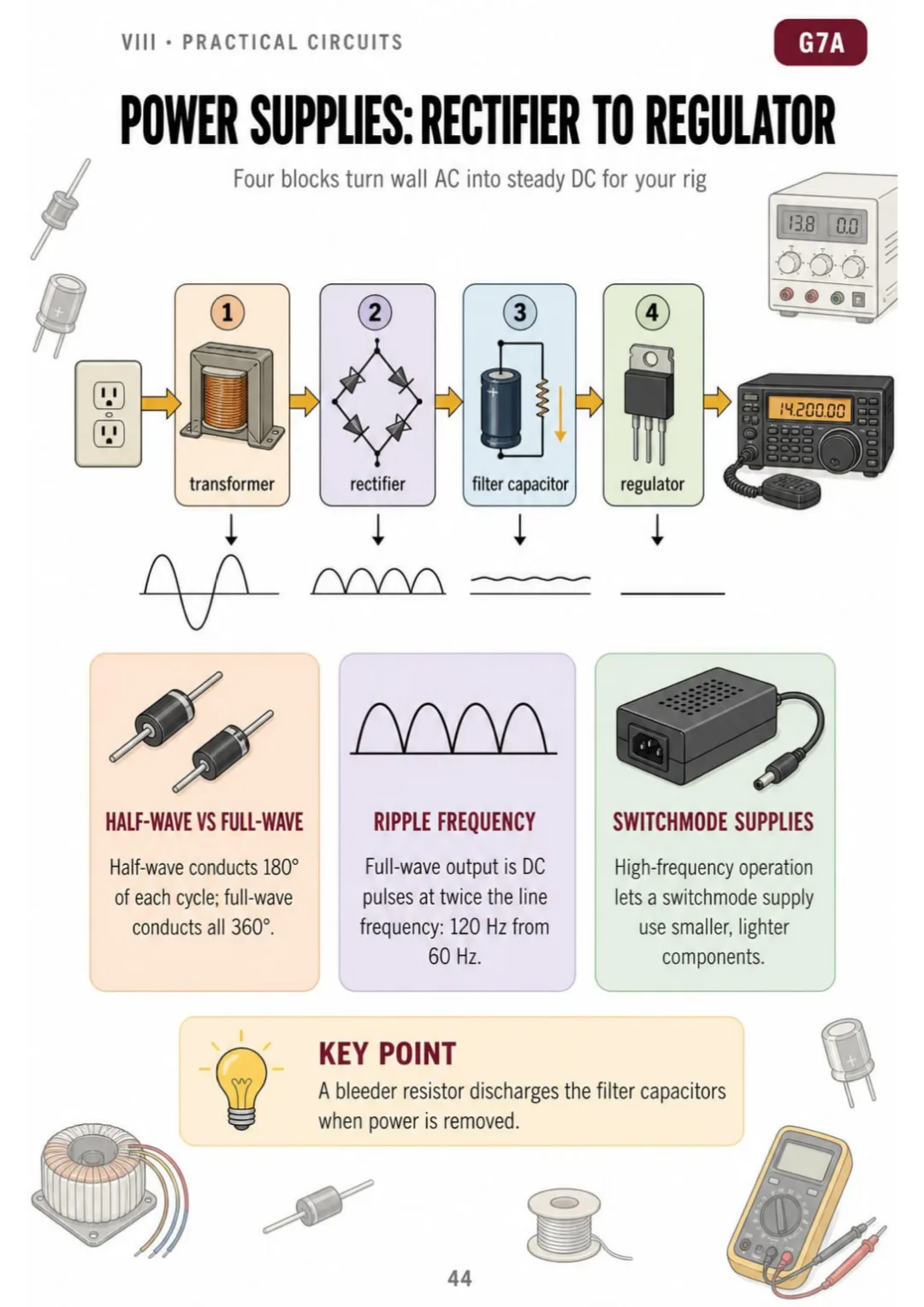
Transformer → rectifier → filter → regulator, with the waveform under each block

Swipe to see more →

These are real pages from the book. The table of contents is the full one: 12 parts and 64 topics.

It's That Nobody Put It in Order for You.

You've read the sideband rule three times. You close the app...

...and you're not sure anymore if 40 meters is LSB or USB. It was just lines of text.

LSB below 10 MHz, USB above it, and USB on the 60 m channels.

Here the sideband rule is one page: a single line at 10 MHz, LSB below it, USB above it, and the 60-meter channels marked USB.

And on the pages next to it, each topic gets its own: the band edges, the ionosphere, decibels, SWR and the power supply.

First you understand why it works that way. Then the rule just stays with you.

SEE THE DIFFERENCE

Stop memorizing band edges you can't picture:

THIS
  • Pages and pages of dense text
  • Band edges without a single drawing
  • On exam day, you don't know where to start
Pursuant to 47 CFR §97.301(d), the control operator of a station holding a General Class license may transmit on specified frequency segments within the 160, 80, 60, 40, 30, 20, 17, 15, 12 and 10 meter bands, subject to the emission limitations set forth in §97.305. In the 20 meter band, General Class privileges extend from 14.025 to 14.150 MHz for CW, RTTY and data emissions and from 14.225 to 14.350 MHz for phone and image emissions, the intervening segment being reserved for higher license classes.
FOR THIS
  • Every band drawn as a bar
  • One topic per page, with the rules in boxes
  • You remember it because you've seen it
20 m: 14.025-14.150 MHz CW/data · 14.225-14.350 MHz phone
CONTENTS

Take a Look at the 12 Parts and 64 Topics

The exam, the rules, operating, propagation, station practices, electrical principles, components, circuits, signals, antennas, RF safety and exam practice: 12 parts, every topic drawn

IThe General Exam · pp. 6-8
  1. Element 3: How the General Exam Works
  2. The 10 Subelements on One Map
  3. A Study Plan by Subelement
IIG1 Commission's Rules · pp. 9-14
  1. Your New HF Privileges on One Chart
  2. Primary and Secondary Allocations
  3. Antenna Height, Beacons and Prohibited Transmissions
  4. Power Limits and the 60-Meter Channels
  5. Volunteer Examiners, Element Credit and Your Upgrade ID
  6. Control Categories, Repeaters, Third Parties and ITU Regions
IIIG2 Operating Procedures · pp. 15-21
  1. USB or LSB: Which Sideband Where
  2. Calling CQ, Breaking In and Answering DX
  3. Band Plans and Operating Effectively
  4. Emergencies, Drills and RACES
  5. CW Procedure, Q Signals and Full Break-In
  6. Volunteer Monitors and HF Courtesy
  7. Digital Mode Operating: FT8, RTTY and Winlink
IVG3 Radio Wave Propagation · pp. 22-27
  1. The Ionosphere: D, E and F Regions
  2. Sunspots, Solar Flux and the K and A Indices
  3. MUF and LUF on One Graph
  4. Critical Angle, Skip Zone and NVIS
  5. Short Path, Long Path and HF Scatter
  6. Reading Propagation Conditions
VG4 Amateur Radio Practices · pp. 28-33
  1. Station Setup: Transceiver, Tuner and Amplifier
  2. Test Equipment: Oscilloscope, Analyzer and Two-Tone Test
  3. RF Interference to Consumer Electronics
  4. Grounding and Bonding the Station
  5. Speech Processors, S Meters and Band-Edge Sidebands
  6. Mobile, Portable and Solar-Powered Stations
VIG5 Electrical Principles · pp. 34-39
  1. Reactance and Impedance in One Drawing
  2. Resonance
  3. Decibels Without Fear
  4. Power, RMS and PEP
  5. Series and Parallel: R, L and C
  6. Transformers and the Turns Ratio
VIIG6 Circuit Components · pp. 40-43
  1. Diodes, Transistors and Vacuum Tubes
  2. Capacitor, Inductor and Battery Types
  3. ICs, MMICs and Displays
  4. RF Connectors and Ferrite Cores
VIIIG7 Practical Circuits · pp. 44-49
  1. Power Supplies: Rectifier to Regulator
  2. Schematic Symbols You Must Know
  3. Digital Logic Basics
  4. Amplifier Classes and Oscillators
  5. Inside a Superhet Transceiver
  6. Filters and DSP
IXG8 Signals and Emissions · pp. 50-55
  1. AM, FM and SSB Side by Side
  2. The Modulation Envelope and Overmodulation
  3. Mixers, Multipliers and Bandwidth
  4. FM Deviation and Intermodulation
  5. Digital Emission Modes
  6. Link Budgets and Link Margin
XG9 Antennas and Feed Lines · pp. 56-60
  1. Feed Lines: Impedance and Loss
  2. SWR: Calculate, Measure and Match
  3. Dipoles and Verticals
  4. Yagis and Directional Antennas
  5. Loops, NVIS and Specialized Antennas
XIG0 Electrical and RF Safety · pp. 61-64
  1. RF Exposure and Your Station Evaluation
  2. Electrical Shock, Fuses and Interlocks
  3. Station Grounding and Lightning
  4. Tower and Antenna Safety
XIIExam Practice · pp. 65-69
  1. Exam-Style Questions 1-7
  2. Exam-Style Questions 8-14
  3. Exam-Style Questions 15-21
  4. Exam-Style Questions 22-28
  5. Exam-Style Questions 29-35

What If Every Topic Fit on a Single Page?

Picture this:

Instead of rereading half a page about the ionosphere without being able to see it...

...you open the page and find the D, E, F1 and F2 layers drawn over one curved Earth, the day side next to the night side.

Transceiver → amplifier → tuner → feed line → antenna, with the ALC line drawn in

And band edges, sidebands, decibels, SWR and RF safety turn into drawings and charts you can read at a glance.

You stop memorizing and start understanding.

That's The General Class Sketchbook: 12 parts and 59 topics, each one drawn on its own page, in the same order as the G1 to G0 syllabus. And at the end, 35 original exam-style questions to see where you stand.

Because what your brain sees organized, it remembers.

Here Is What You Get with The General Class Sketchbook:

Ipp. 6-8

The General Exam

How Element 3 works (35 questions, 26 to pass), the 10 subelements on one map and a study plan by subelement.

IIpp. 9-14

G1 Commission's Rules

Place any frequency in its segment at a glance: your HF privileges on one chart, primary and secondary allocations, antenna height and beacons, power limits and the 60-meter channels, VEs and your upgrade ID, control categories and ITU regions.

IIIpp. 15-21

G2 Operating Procedures

Which sideband where, calling CQ and answering DX, band plans, emergencies and RACES, CW and Q signals, HF courtesy, and FT8, RTTY and Winlink.

IVpp. 22-27

G3 Radio Wave Propagation

The D, E and F regions, sunspots and the K and A indices, MUF and LUF, skip zone and NVIS, long path and scatter, and how to read conditions.

Vpp. 28-33

G4 Amateur Radio Practices

Transceiver, tuner and amplifier, the scope and the two-tone test, RF interference, grounding and bonding, speech processors and S meters, and mobile and solar stations.

VIpp. 34-39

G5 Electrical Principles

Reactance and impedance, resonance, decibels, RMS and PEP, series and parallel R, L and C, and the transformer turns ratio.

VIIpp. 40-43

G6 Circuit Components

Diodes, transistors and tubes, capacitor, inductor and battery types, ICs and MMICs, RF connectors and ferrite cores.

VIIIpp. 44-49

G7 Practical Circuits

Power supplies, schematic symbols, digital logic, amplifier classes and oscillators, the superhet transceiver, filters and DSP.

IXpp. 50-55

G8 Signals and Emissions

AM, FM and SSB side by side, overmodulation, mixers and bandwidth, FM deviation and intermod, digital modes and link budgets.

Xpp. 56-60

G9 Antennas and Feed Lines

Feed line impedance and loss, SWR calculated and measured, dipoles and verticals, Yagis, loops and NVIS antennas.

XIpp. 61-64

G0 Electrical and RF Safety

RF exposure and your station evaluation, shock, fuses and interlocks, grounding for lightning, and tower safety.

XIIpp. 65-69

Exam Practice

35 original exam-style questions in five sets of seven, to test yourself from G1 to G0.

At the end of the book: 35 original exam-style questions to test yourself, G1 to G0.

And That Is Not All: 2 More Books, Free

General HF Band Chart, Printable

BONUS 1: «General HF Band Chart, Printable»

Value on its own: US$ 17.90

All your General privileges band by band, from 160 m to 10 m, with the CW/data and phone segments marked. You get one wall chart and one pocket version, so finding a band edge takes a glance instead of a search through the rules.

250 General Class Terms on Cards

BONUS 2: «250 General Class Terms on Cards»

Value on its own: US$ 14.90

Quiz yourself in five-minute gaps with 250 printable cards (MUF, LUF, NVIS, PEP, SWR, ALC, VFO, DSP...). Each has the term on the front and a one-line definition with a tiny sketch on the back.

The General Class Sketchbook + 2 Free Books

  • The General Class Sketchbook: 69 illustrated pagesUS$ 63
  • BONUS 1: General HF Band Chart, PrintableUS$ 17.90
  • BONUS 2: 250 General Class Terms on CardsUS$ 14.90
  • High-resolution PDF to printIncluded
Total value US$ 95.80
YOUR PRICE:
US$ 27
You save US$ 68.80
YES, I WANT THE GENERAL CLASS SKETCHBOOK FOR US$ 27

📄 This is a digital PDF book sent to your email: nothing is printed or shipped.

Secure purchaseEncrypted payment30-day guarantee

PDF by email: The General Class Sketchbook reaches your inbox as a PDF, and the two free books come by email too. One-time payment, no installments or hidden costs.

Is This Book for You?

You're studying for your upgrade

You're studying for your upgrade

Band edges, sidebands, propagation and the four formulas, one topic per page, in the same order as the G1 to G0 syllabus.

Your exam session is coming up

Your exam session is coming up

A fast review of all of Element 3, and at the end 35 original exam-style questions to see where you stand, whether it's your first try or a retake.

You already have your General

You already have your General

A visual refresher before you go on the air: your band edges, which sideband where, how the ionosphere changes after dark and the RF safety basics.

To Sum Up: Here Is What You Get

US$ 95.80US$ 27
YES, I WANT THE GENERAL CLASS SKETCHBOOK FOR US$ 27

📄 This is a digital PDF book sent to your email: nothing is printed or shipped.

30DAYS
GUARANTEE

30-Day Guarantee

30-day guarantee: tell us what didn't work and we'll refund 100%.

You have 30 days to try The General Class Sketchbook and both bonus books. If it doesn't work for you, tell us what didn't work and we'll refund 100% of what you paid. One-time payment, no subscriptions and no surprises.

Frequently Asked Questions

How do I get it?

It's a digital book, not a printed one. You get The General Class Sketchbook as a high-resolution PDF by email, at the address you enter at checkout, to read on your phone, tablet or computer, or to print. The two bonus books, General HF Band Chart, Printable and 250 General Class Terms on Cards, come by email too.

Is it a monthly payment or a one-time payment?

A one-time payment of $27. No installments and no subscription.

Who is it for?

For Technician licensees upgrading to General, for anyone preparing for an Element 3 exam session (including a retake) and for new General operators who want a visual refresher. If math isn't your thing: the math pages (Ohm's law, decibels, PEP, SWR) are drawn with worked numbers, like 12 V across 6 Ω = 2 A and 24 W. And it doesn't replace your practice app: the app drills the answer, the page shows you why it's right. It covers Element 3 only: Element 2 (Technician) and Amateur Extra are not included. Check the table of contents above.

What sources is it based on?

On 47 CFR Part 97 (sections 97.301, 97.303, 97.305, 97.501 and 97.503, on eCFR) and on the official NCVEC General Class question pool syllabus for 2023-2027, including the errata of February 4, 2026. Every number on a drawing matches its text.

Is this official material?

No. It's an independent study book, not published, approved or endorsed by the FCC, NCVEC, ARRL, W5YI or any VEC. Rules can change: always check 47 CFR Part 97 and your VE team.

Does it replace a class or a license manual?

No. It's a visual companion to the official pool, your class or manual and time on the air. The G0 pages on RF exposure and electrical safety are exam content, not medical or engineering advice.

Are the practice questions the ones on the exam?

No. The 35 questions are written for this book in the exam style. They aren't copied from the official pool and aren't official exam questions: they're there for practice.

Can I print it?

Yes. Print the whole book or just the pages you need, at home or at a print shop. The band chart comes in a wall version and a pocket version.

What if I don't like it?

You have 30 days. Tell us what didn't work and we'll refund 100%.

One Last Thing Before You Decide...

You don't have to reread the same page hoping it sticks this time.

You don't have to memorize band edges you can't picture.

And you definitely don't have to walk into your exam session not knowing where to start.

There's a simpler way. And it's one click away. Now it's your turn.

One-time payment: US$ 27 · Guarantee: 30 days · PDF by email

YES, I WANT THE GENERAL CLASS SKETCHBOOK FOR US$ 27

📄 This is a digital PDF book sent to your email: nothing is printed or shipped.